Sleep Health
Waking in the small hours: what ordinary sleep architecture looks like
Brief waking during the night is a normal feature of sleep rather than a fault. What determines the outcome is what happens after the waking.
Sleep is cyclical rather than continuous
Sleep proceeds through repeating cycles that move between lighter and deeper stages, with each cycle lasting roughly an hour and a half in most adults. Brief returns towards wakefulness occur at the boundaries between cycles, and they happen several times across an ordinary night in people who sleep well. Most of these are never remembered, because a period of wakefulness generally has to last a little while before it is encoded into memory at all.
This is why someone can be observed waking repeatedly in a laboratory and report the following morning that they slept straight through. The awakenings are a feature of how sleep is organised rather than a sign that anything has gone wrong.
Why the second half of the night differs
Deep sleep is concentrated in the earlier part of the night, while the later cycles contain proportionally more of the lighter stages and more dreaming sleep. This means waking is both more likely and more likely to be remembered towards morning, which explains why the small hours feature so heavily in complaints about sleep. The internal clock is also approaching its waking signal by then, so the pressure holding sleep in place has weakened considerably.
Anything that disturbs sleep therefore has a greater effect late in the night than the same disturbance would have had earlier. The distribution shifts across adulthood, with deep sleep becoming less abundant, which is an ordinary change rather than a disorder.
What turns a brief waking into a long one
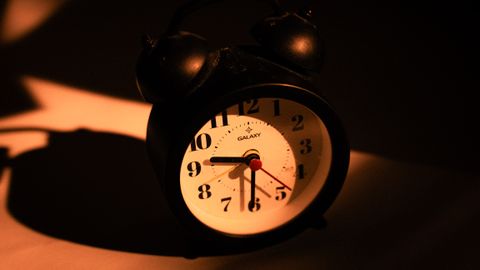
Waking briefly is common, and what determines whether it extends is largely the response to it rather than the waking itself. Checking the time, calculating how much sleep remains and becoming concerned about the following day all raise arousal at the moment it needs to fall. That reaction is entirely understandable and it is also the mechanism by which an ordinary awakening becomes an hour of lying awake.
The pattern can become self-sustaining, since anticipating the waking on subsequent nights raises arousal before it has even occurred. This self-sustaining quality is a central feature of long-term insomnia and is what the structured therapies are designed to address.
Historical and cultural variation
There is an argument that segmented sleep, divided into two periods with a wakeful interval between them, was once a common pattern in some societies. The evidence for this rests largely on historical documents and is interesting rather than settled, and it is often overstated in popular retellings. What it does usefully suggest is that expectations about a single unbroken block may be more cultural than biological in origin.
Someone who wakes and lies calmly for a while before sleeping again is not experiencing a malfunction, whatever the expectation says. Loosening the expectation appears to reduce the distress, which in turn reduces the arousal that extends the waking.
When waking at night needs attention
Waking repeatedly with breathlessness, chest discomfort, palpitations or a need to pass urine several times a night points towards a medical cause. Loud snoring interrupted by pauses, particularly with daytime sleepiness, is a specific reason to seek assessment for a breathing disorder during sleep. Waking very early with low mood that is worst in the morning is a recognised pattern that should be discussed with a doctor rather than managed alone.
Persistent difficulty returning to sleep over months, with daytime consequences, meets the ordinary description of insomnia and has established treatments. None of these are addressed by general reassurance about sleep architecture, which applies to ordinary variation rather than to symptoms.
- Brief awakenings are a normal part of the cycle
- Most are forgotten unless something makes them memorable
- Distress after waking is what extends it
Also by Priya Patel
- Where the eight-glasses rule came from, and why it survived without supportHydration Tips
- Walking pace, terrain and why the same distance is not the same effortPhysical Activity
- The gap between a nutrient on a label and a nutrient in a bodyClean Eating
- Reading a health claim: the questions that separate evidence from packagingTop