Physical Activity
Why strength work matters for people with no interest in being strong
The relevant outcomes are the ordinary tasks that quietly become harder. Muscle and bone respond to loading in ways nothing else replicates.
Adaptation follows the demand
Muscle, tendon and bone all adjust to the loads they regularly encounter, becoming stronger under increased demand and receding when the demand is removed. This specificity means the adaptations produced by resistance work are not produced to the same degree by walking or by endurance activity. The two therefore address different things, which is why guidance generally recommends some of each rather than treating them as alternatives.
The response to loading persists into later life, and the capacity to gain strength has been observed in people well beyond the ages usually assumed. That persistence is one of the more encouraging findings in this area and is frequently absent from how the subject is presented.
The outcomes that actually matter
The relevant measures for most people are not lifting figures but ordinary tasks such as carrying shopping, climbing stairs and rising from a low chair. These depend on having reserve capacity, since a task performed close to maximum feels difficult and is more likely to be avoided over time. Avoidance reduces the loading further, which reduces capacity, which makes the task harder again in a loop that unfolds slowly over years.
Interrupting that loop is the practical argument for strength work, and it has nothing to do with appearance or with athletic performance. It also explains why the benefit is most visible in the tasks a person had stopped noticing they were finding harder.
Bone and the loading it needs
Bone is living tissue that remodels in response to mechanical loading, and it responds particularly to loads that are relatively large or applied quickly. This is why weight-bearing and resistance activity are discussed in the context of bone while non-weight-bearing activity such as swimming is not. The relationship is well established in broad terms, and the specifics of what loading suits whom remain an area of ongoing investigation.
Anyone with diagnosed bone thinning, or at particular risk of fracture, needs individual guidance rather than general principles about loading. That is a clear case where a clinician or a physiotherapist should be setting the parameters rather than an article or an application.
What the practice actually requires
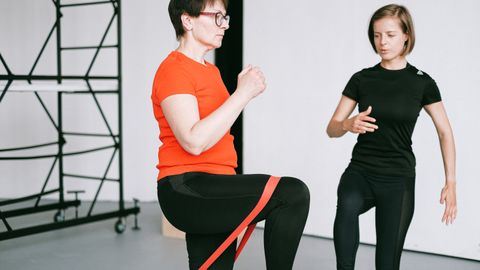
Resistance work does not require a gym, since bodyweight movements and simple household objects supply loading sufficient for a large part of the population. Progression is what drives adaptation, meaning the demand has to increase gradually over time rather than remaining fixed indefinitely. Technique matters mainly for reducing injury risk and for ensuring the intended tissues receive the load, which is where instruction pays for itself early.
Frequency of a couple of sessions a week appears in most guidance, which reflects the pattern of recovery between sessions rather than an arbitrary figure. Soreness after unfamiliar work is common and is not a measure of whether the session was useful.
Starting sensibly and knowing when to ask
Anyone with a heart condition, uncontrolled blood pressure, a recent injury or a history of joint problems should take advice before beginning resistance work. Pain during a movement, as distinct from effort, is a reason to stop and reassess rather than something to be worked through. Sharp pain, swelling or a joint that gives way are specific reasons to seek assessment rather than to continue with a modified version.
Nothing here constitutes a programme, since a suitable programme depends on individual history, current capacity and any existing conditions. A physiotherapist or a qualified instructor is the appropriate source for that, particularly for anyone starting after a long period of inactivity.
- Tissues adapt specifically to the loading they receive
- Everyday capacity depends on reserve
- Technique and progression matter more than load
Also by Emily Davis
- Daily hassles, not major events, and where the load actually comes fromStress Management
- What a sleep tracker measures and what it only estimatesSleep Health
- Fibre, fullness and why the same meal lands differently on different daysClean Eating
- Why small changes hold and total overhauls tend to collapseTop